CALL FOR PARTICIPANTS: SURVIVAL & RECOVERY IN VICTIM-SURVIVORS OF ADULT CLERGY SEXUAL ABUSE
Have you experienced sexual grooming, sexual abuse, or sexual coercion by a Christian faith leader when you were age 16 or older?
You are invited to participate in a confidential research study exploring survival, recovery and growth following clergy sexual abuse.
This research study invites English-speaking adults worldwide to share their experiences anonymously via an online survey (45–60 minutes).
For people subjected to abuse in Australia, there is also an option to participate in a confidential interview.
Your story can help shape a better understanding of clergy abuse and contribute to trauma-informed change in faith spaces.
✅ Must be 18+
✅ Must have been 16+ at the time of the abuse (or if abuse continued after age 16).
✅ Your experience must involve a Christian faith leader of any Christian faith denomination.
You will have the opportunity to describe your experience in your own words, using language that feels right to you.
Scan the QR code in the image attached to find out more.
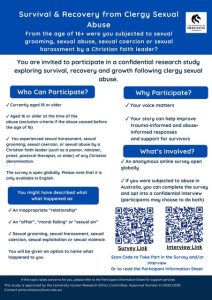
Or click on the following links:
Survey link: https://uninewcastle.questionpro.com.au/survivalandrecovery
Interview link: https://uninewcastle.questionpro.com.au/interview
For further information, please email: Jaime.Simpson@uon.edu.au
Important privacy notice:
Please note that if you like, share, or comment on this post, your activity may be visible to others or appear on your own or others’ social media feeds.
If you would like to share, please turn off commenting if your platform allows it.
Please note that, due to confidentiality, communication from the researcher will occur only via university email. Direct messaging via social media will not be used, except to provide the study link.
This study has been approved by the University of Newcastle Human Research Ethics Committee, Approval No. H-2025-0335.